Popular
Innovation examples
In vitroOrgan-on-Chip
Unified organoid system for modeling heart and kidney interaction on-a-chip
Beatrice Gabbin is a PhD candidate at the Anatomy and Embryology Department of the Leiden University Medical Center. Her project is shared with the Nephrology Department and focusses on the study of the cardiorenal axis in vitro. Both heart and kidneys have vital functions in the human body and reciprocally influence each other’s behavior: pathological changes in one can damage the other. There are already multiple independent in vitro (human) models of heart and kidney, but none have so far captured their dynamic crosstalk. The aim of the project is therefore to develop a microfluidic system which can be used to study heart and kidney interaction in vitro. For this purpose, cardiac microtissues and kidney organoids derived from human induced pluripotent stem cells are generated and loaded onto a 3D perfusion chip for their dynamic co-culture. This system enables the study the cardiac and kidney interaction with a high level of control. The validation of a unified organoid system will enable the investigation of diseases involving the two organs and their potential treatments. Read more via the link in the video and https://doi.org/10.1016/j.mtbio.2023.100818.
Innovation examples
HealthToxicology
Zebrafish in toxicity testing
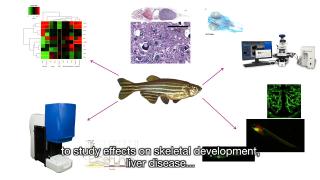
Zebrafish are increasingly recognised as a useful model for toxicity testing of chemical substances. Testing strategies are becoming more based on mechanisms of toxicity structured in adverse outcome pathways describing the chain of events leading to toxicity or disease. Using a battery of dedicated in vitro and in silico assays, insight can be gained in how exposure leads to disease. For certain diseases it is known that toxicity relies on the interaction between different organs and cell types, which requires research on whole organisms in addition to simple in vitro models. The zebrafish is considered a valuable whole organism model in a mechanism-based testing strategy. At RIVM, the zebrafish embryo model is used for testing the effect of chemical substances on several adverse outcomes and diseases.
For more information see: https://ehp.niehs.nih.gov/doi/10.1289/EHP9888; https://doi.org/10.3390/ijerph18136717; www.linkedin.com/in/harm-heusinkveld

Innovation examples
HealthInnovationIn silico
Using data and computational modelling in biomedical research
Bioinformatics and systems biology hold great promise to translate the wealth of biological data into meaningful knowledge about human health and disease. The group of Bas Teusink helps biologists to deal with high throughput data, for example metabolomics (how cell metabolism works) and proteomics (how protein networks work) from patient material or cell cultures. This can help to better understand disease mechanisms and aid drug targeting or personalised medicine. In the future, combining data from different models (in vitro, in vivo and human data) could become a digital model of humans, or a “ digital twin”.
Click on the link in the video to watch more or read the interview with Bas (and Jaap Heringa) he[https://vu.nl/en/research/more-about/using-data-and-computational-modelling-in-biomedical-research]re.
Innovation examples
HealthIn vitroOrgan-on-Chip
An iPSC-derived blood-brain barrier to model neurodegeneration
The blood-brain barrier is a layer of cells that protects our brain from harmful compounds. However, due to this tight barrier, many drugs to treat neurological diseases cannot enter the brain either.
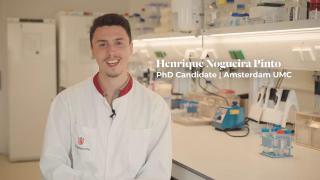
There are currently no good models to test these types of drugs. Henrique Nogueira Pinto is a PhD candidate at the Vrije Universiteit in Amsterdam. He is developing a blood-brain barrier model coupled to mini-brains. With this model, he aims to more reliably test how drugs can be transported over the blood-brain barrier and what their effect on the brain is.
Click on the info button for the full version of the video. Click here (https://fluidsbarrierscns.biomedcentral.com/articles/10.1186/s12987-022-00316-0#Sec3) for a review of the current status of in vitro models for the blood-brain barrier.
New
Questions
HelpathonsPolicyBeginner
Helpathon #12 – Can you help Erica?
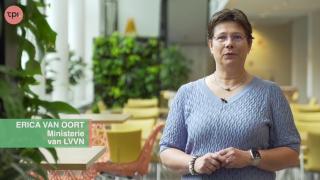
We are inviting Dutch-speaking citizens from all walks of life to join a unique Helpathon and help Erica van Oort, coordinator of the Animal-Free Transition Program (TPI) in the Netherlands. No prior knowledge of animal testing is required—your fresh perspective can help Erica communicate more effectively about animal-free research.
We strongly believe that well-informed citizens are key to improving democratic policy-making on health research, with and without animals. Please share this invitation to at least one suitable person who could contribute—and of course, you are warmly welcome to join as well.

Projects and initiatives
HealthToxicology
The NAM Navigator: A unique repository for information on the validation and acceptance of New Approach Methodologies
The NAM navigator is an innovative knowledge portal to navigate you to and through valuable information on the development, standardization, validation and acceptance of New Approach Methodologies (NAM). The NAM Navigator acts as an online guide that provides specific information needed in each of these steps, thereby increasing the broad use of animal-free innovations. Follow the link in the video to start navigating!
Projects and initiatives
HealthToxicologyIn vitroIn silico
VHP4Safety project
The safety testing of chemicals and pharmaceuticals traditionally relies on animal studies. However, these raise ethical concerns and often fail to accurately predict human responses. New scientific developments offer opportunities to build a Virtual Human Platform (VHP) for safety assessment, a platform that enables assessment based solely on human physiology and biology, integrating data from in vitro and in silico models. This video explains how we are developing the VHP through an interdisciplinary approach. Read the paper in the videolink or visit or VHP4Safety (https://vhp4safety.nl/) for more information.
Innovation examples
HealthToxicologyIn silico
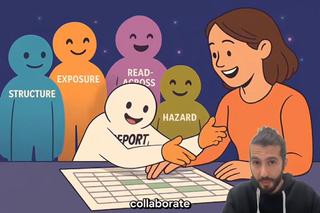
AI agents for safer science: How AI is Changing Chemical Risk Assessment
This video introduces a novel approach to chemical safety, where intelligent digital agents guided by large language models support scientists in making faster, more transparent decisions. By automating complex workflows and integrating tools like the OECD QSAR Toolbox, these agentic systems help prioritise research, reduce reliance on animal testing, and pave the way for safer, more sustainable innovation.